

Printed in the Winter 2026 issue of Quest magazine.
Citation: Smoley, Richard "The Spectrum of Consciousness: An Interview with Ken Wilber" Quest 114:1, pg 12-18
By Richard Smoley
Ken Wilber is one of the most dynamic and respected thinkers of recent generations. His numerous books include The Spectrum of Consciousness; Up from Eden: A Transpersonal View of Human Evolution; The Atman Project: A Transpersonal View of Human Development; Sex, Ecology, and Spirituality: The Spirit of Evolution; and, most recently, Finding Radical Wholeness: The Integral Path to Unity, Growth, and Delight.
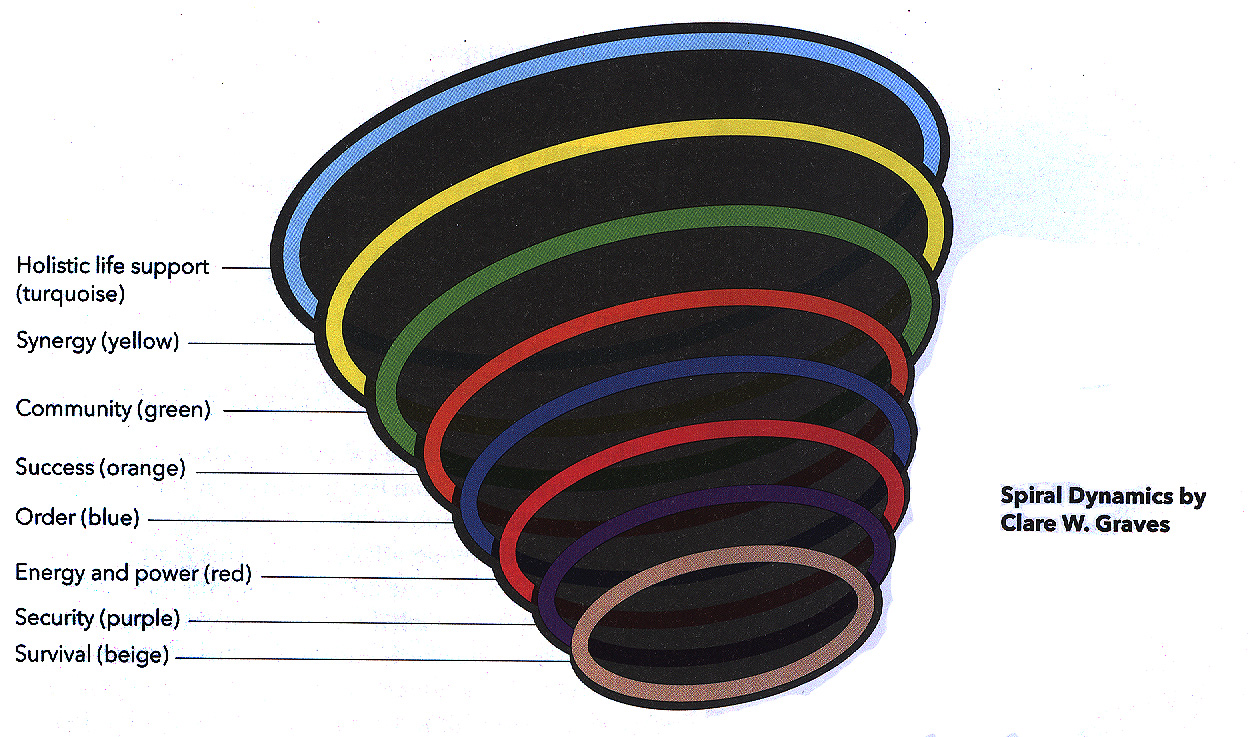
One of the central themes of Wilber’s works is the evolution of consciousness from the most basic atomic particles all the way up to the human level and beyond. Influenced by figures such as the Swiss philosopher Jean Gebser, he relates the various stages of human history to different levels of development in human consciousness. Wilber also makes use of the Spiral Dynamics system developed by psychologist Clare Graves (see diagram), with his own modifications.
In this interview, conducted by Zoom in June 2025, Wilber discusses these ideas and their relation to the present day.
Richard Smoley: I’’ll start with one concept that seems to be central to your philosophy, which is the evolution of consciousness. The idea is not only that consciousness has evolved from, say, the days of the paramecium, but it has also evolved in historical times over recent centuries. Could you talk about your views on that point?
 Wilber: Sure. There’s a fairly widespread school of philosophy in the West called panpsychism, and panpsychism maintains that what we call the psyche, or the mind, is pan-, or present everywhere. That means that atoms have a bit of mental capacity. Molecules have a bit of mental capacity. Single-celled organisms have a mental capacity. Multicellular organisms have a mental capacity, and all the way up the tree of life from fish, amphibians, reptiles, and mammals, to humans, which have the highest reach of mental capacity.
Let me say something about what I mean by mental capacity, because I don’t like the term panpsychism. The reason is that psyche is too complex a term for the type of mind that a proton or a neutron or an atom has. I much prefer Alfred North Whitehead’s term: prehension, because prehension just means touching or feeling, and that touching is the type of mentality that an atom has: an atom touches other atoms, and those atoms together make up molecules, and molecules touch other molecules.
When a bunch of molecules come together, they form single-celled organisms, and those single-celled organisms touch other single-celled organisms to form multicellular organisms, and those go all the way up the tree of life, from fish to amphibians, to reptiles, to mammals, to humans.
Their mentality also goes through a variety of stages of development; this was discovered by America’s second greatest psychologist, James Mark Baldwin (America’s greatest psychologist, is, of course, William James). He wrote a book called Thoughts and Things. Baldwin invented developmental psychology, which is the study of the stages of mental growth (or of prehensive growth) that humans went through. He took the fairly common Western philosophical tradition, focusing on so-called goodness, truth, and beauty, and found that each of them went through a series of stages of unfolding or development. He named those stages things like prelogical, logical, translogical, and integral.
The good, the true, and the beautiful. The good involved the stages of moral development: how we treat each other with goodness and care and concern and morality. He took truth to mean scientific, objective truth. And then the beautiful, which was beauty in the eye of the beholder, or of the pronoun I.
To these three he added religion, because he noticed that religious belief also went through the same stages of development. So that gave us four different lines of development. Baldwin actually discovered around seven or eight total levels of development.
That was the beginning of developmental psychology. By the 1950s these stages of development had become fairly well known among the psychological community, and there was an outburst of many different models. Psychologists came to realize that there are around a dozen or so different types of intelligence: cognitive intelligence; moral intelligence; ego development, or ego intelligence; spatial; mathematical; musical; and so on.
Each psychologist, unknowingly, singled out a particular multiple intelligence and studied the growth of that intelligence. Abraham Maslow chose a needs hierarchy of development. Jean Piaget chose a cognitive line of development. Lawrence Kohlberg chose a moral line of development. Jane Loevinger studied ego development. Each major researcher selected a particular type of intelligence, studied the stages of growth that it went through, and found that everybody went through these stages. If they continued to grow and develop, they went through all eight or so major levels.
These psychologists were all describing the same basic levels. But because each of them was dealing with a different line of development, each gave these levels different names. Piaget gave cognitive names to his stages: sensory-motor intelligence; preoperational intelligence; concrete operational intelligence; formal operational intelligence; and systemic or integral intelligence. Kohlberg named them according to the stages of moral development: preconventional, conventional, postconventional, and systemic.
Eventually they realized all of them were dealing with the same basic levels, even though they each gave them different names. That became the first full-fledged developmental model of consciousness.
Jean Gebser argued that each of these levels unfolded at a different time in human history. He gave names to these stages: archaic, magic, mythic, rational, pluralistic, and integral.
The earliest, which he called the archaic stage, was our basic transition from the great apes into Homo sapiens, which started around 400,000 years ago. That went to the so-called preoperational stage. This was a kind of magic belief, because the mind had not yet fully differentiated from that which it was aware of. As it started to invent symbols and words and an alphabet, it wrote, say, the word tree. That was called the signifier. The signified is what came to your mind when you read the signifier. Whenever you word the word tree, you form an image of a real tree in your mind. The actual referent of the signifier tree is the real tree. But because the mind had not yet fully differentiated the symbol tree from the real referent, or the real tree, it couldn’t distinguish between operating on the signifier and operating on the real tree. So if it changed the signifier, or the word tree, they felt that it magically changed the real tree. That was just one of the very earliest predifferentiated stages of development. It was called magic: if you change the signifier, you magically changed the referent, because they weren’t clearly differentiated.
Then, in the mythic stage, human beings learned to differentiate the signifier from the referent. This began to happen around 50,000 years ago. But they didn’t get rid of magic. They just themselves could no longer perform magic, because they had fully differentiated the signifier from the referent. Instead, they transferred the capacity for magic to a whole host of heavenly gods, goddesses, divine nature, spirits, and so on. If we prayed to those heavenly beings with a great deal of sincerity and belief, we could ask them to perform magic on our behalf. We would often pray for them to make crops grow. In today’s world, we’d pray to them to get a new car, or a girlfriend or boyfriend. If we prayed with a great deal of sincerity, they would magically get us the car, the new house, or the pay raise, or whatever we wanted.
Then, as we moved into the Common Era, around the time of Christ, we moved into concrete operational thinking, which Piaget defined as thought operating on the real world. An example of concrete operational thinking would be: I go in the garage, I get my bike, I pull it down from the wall, I get on it, I put my feet on the pedals, and I start pedaling. All of these are concrete operational behaviors because they’re me concretely operating on the world. My thought is operating on concrete items.
By the time we reached the Western Renaissance and Enlightenment, formal operational cognition started to emerge: we started using things like logic or mathematics, which is thought operating on thought, not just on the concrete world. Thought operating on thought gave us rationality, logic, and mathematics.
The next stage is one that I call green. Here it is noticed that rationality forms single, universal, holistic systems. There isn’t Protestant chemistry versus Hindu chemistry versus Buddhist chemistry: there’s just chemistry. It’s a single, unified science, and it applies to everywhere on the planet and to every human being on the planet. So it forms single, unified systems of thinking.
That’s what rationality does, and that’s what science does. So we have multiple sciences: chemistry, biology, physics, psychology, sociology. Each of those are separate individual items. But they apply to the single universal system. There’s only one basic chemistry, only one basic biology, only one basic psychology, and so on.
Then the next stage starts to notice: “Wait a minute. There are all sorts of different cultures around the world. There’s French culture, German culture, Chinese culture, American culture, and so on. And each of those have separate but important truths.” We call that multiculturalism. That was discovered roughly in the 1950s and ’60s.
We call that multiculturalism or pluralism, or more commonly postmodernism, because it came after modernism, which was formed by rationality and which recognized just a single universal system for each individual science. Multiculturalism recognized a multiplicity of separate truths, each referring to a different multicultural system.
But those green systems could not unify all those multicultural systems. So we just had a plethora of multicultural truths and no way to bring them together. Then came what Clare Graves called “the monumental leap to second tier.” That was when we began to create paradigms out of integrated systems of thinking, which would usually unite two or three separate, individual sciences into a single unit, for example uniting biology and chemistry into biochemistry.
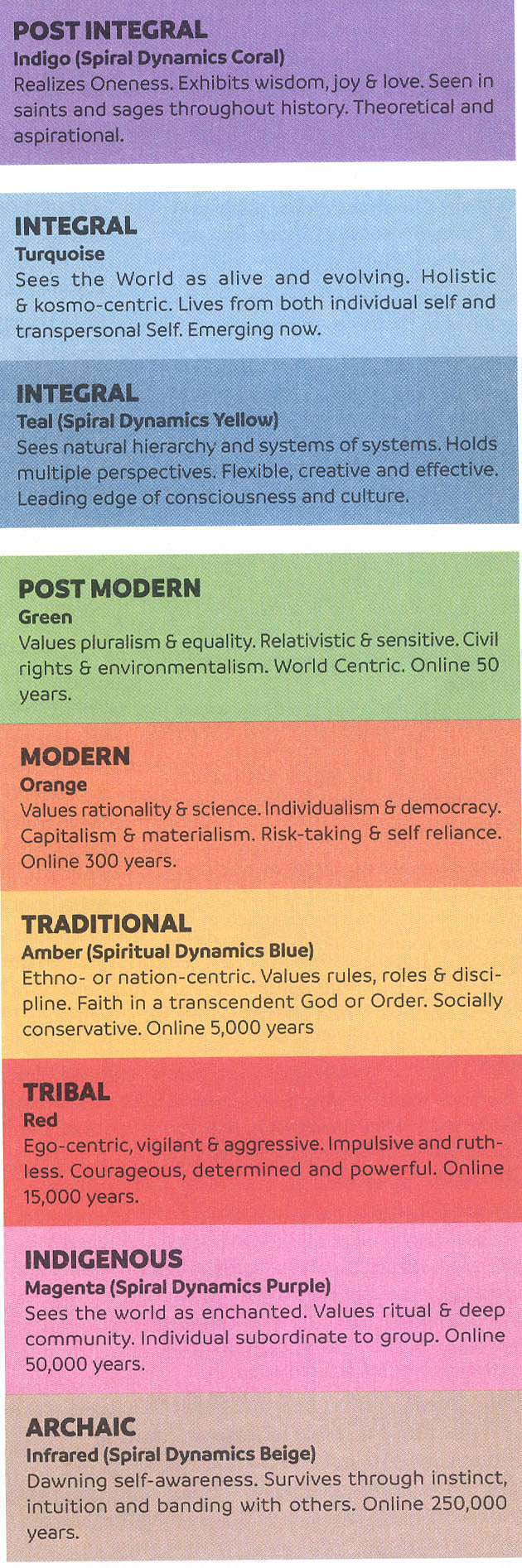
This was often called crossparadigmatic: when they brought together these separate individual multicultural truths. That’s why Claire Grace referred to this stage as a “monumental leap,” because none of the previous stages could unite various paradigms into crossparadigmatic unities. That’s what the integral stages did. So we divide those into teal and turquoise stages, or paradigmatic and crossparadigmatic.
About 5‒7 percent of the population reach the teal or paradigmatic stages, which isn’t very much. But the percentage that reached turquoise—the cross-paradigmatic stage—was significantly less: 0.5 percent. So a very small percent of the population reached turquoise levels. But it was a real stage of development. It was available to everybody who kept growing up to the cross-paradigmatic stage.
That gives us a full history of prehension, which started from the lowest—quarks, protons, neutrons—and continued into atoms and molecules, into single-celled organisms into multicellular organisms, into fish, amphibians, reptiles, mammals, and human beings. Human beings in turn developed through the archaic to magic to the mythic to the rational to pluralistic to integral stages of development. That gave us our entire spectrum of consciousness, of the stages of development that our consciousness went through. That’s the story of our historical unfolding of consciousness.
Smoley: Thank you. That’s very comprehensive. You would seem to be saying that these stages represent a cumulative growth.
Wilber: Right.
Smoley: The contrasting perspective, which is represented by a fair number of thinkers, including Gurdjieff and René Guénon, point to the fact that we may have lost as much as we have gained cognitively. For example, Bushmen could perceive things that Laurens van der Post couldn’t, as he writes in his books. Max Weber spoke of “the disenchantment of the world.” There’s a sense of loss, which may be a cognitive loss as well as an emotional loss. How would you respond to a claim like that?
 |
|
| This diagram expounds the levels of Clare Graves's Spiral Dynamics, as described in Spiral Dynamics: Mastering Leadership, Dynamics, and Change, by Don Edward Beck and Christopher C. Cowan. |
Wilber: That is a fundamental confusion that all retro-romantic thinkers make. The confusion is very easy to understand, because in the first year or so of life, the brain-mind has not yet differentiated itself from the referent. So it comes up with all sorts of symbols, all sorts of words, but those words are not yet differentiated from the thing they represent. The word tree is not differentiated from a real tree, so it appears that there’s a unity in consciousness—and there is. But it’s a prerational unity. It’s not a fully developed mystical unity. If we use the Christian version of the great chain of being, it goes from matter to body—body meaning real, living organisms—to mind, to soul, to spirit.
When you reach the spirit stage and have a unity experience, it’s a unity with all five of those levels: matter, body, mind, soul, and spirit. But that’s not the type of unity that a newborn has. A newborn is one with the material environment, from which it has not yet differentiated itself. That’s not a very high type of unity: it’s not a unity with matter and body and mind and soul and spirit. But if you have a Zen Buddhist satori, a mystical experience from the highest level, it is a unity with all five of those stages of development. If you include models that give eight or even ten stages of development, it’s a unity with all of those stages.
When developmentalists were studying that first, earliest, or archaic stage, they naturally found that the infant could not differentiate itself from the material environment. Being sort of materialistic at heart, the developmentalists looked at that as an absolute unity with the entire universe. But it wasn’t. It was only one with the lowest level of the entire universe, which is a terrifyingly narrow and small type of unity: it’s not a full, complete unity. But the retro-romantics all confuse this ultimate unity with the infantile unity. I myself did this at the very first stage of my own understanding: I felt a unity with the entire world.
But as we grew up and developed into body, mind, soul, and spirit, we’re cutting off our unity with the entire universe. We arren’t: we’re actually growing from the matter to the body stage, and from the body to the mind stage.
At the mental stage the ego starts to emerge, and we get a separation of ego from body and matter. As soon as retro-romantics see the emergence of the ego, they say, “That’s a loss of our profound unity.” They all make that confusion, and that’s why I call it retro-romantic, because it’s a retrogression. It’s not a high level of unity: it doesn’t even get to soul or spirit.
We call them retro-romantics because they have a romantic vision that sees the earlier stage of unity with the material world as a unity with the entire universe. It’s nothing like that at all. It’s a unity with the lowest level of the entire universe.
If you just become one with the material level, you’ve clearly gone backwards from matter, body, mind, soul, or spirit, and you’re just identifying with material level. That’s obviously a regression. You’ve gone back down to the lowest level of the entire universe, which is simple matter. You’re not even at the level of body or mind or soul or spirit.
The people that make the kind of statements that you just summarized are all retro-romantic thinkers, because they all make that same mistake: they think, “I’m going to go back to the unity I had when I was an infant.” No, you’re not. That would be horrifying. If you actually regress back to the material level, you wouldn’t be one with body, mind, soul, or spirit. What kind of unity is that? That’s just a unity with the very lowest level of the material universe, which is nothing to be proud of.
 |
|
| Ken Wilber's variations on the system (chiefly having to do with uses or colors), which he uses in this interview. |
Smoley: Thank you. That’s very enlightening. The model you just presented is one of increased unification and integration of consciousness. How do you relate this to the reality of the present-day world, where there’s an enormous sense of increasing fragmentation and isolation?
Wilber: As you move up this great chain of being, as you go from matter to body to mind to soul to spirit, (or to use Jean Gebser’s six stages, archaic to magic, to mythic, to rational, to pluralistic, to integral), something can go wrong at each of those stages.
You can move from matter to body. When the body level starts to emerge and we begin to identify with our feelings, emotions, and separate ego, that is what Gebser called “magic.” Again, because we haven’t yet fully differentiated the mind from what it’s thinking about, we think that to change the word, or the signifier, is to change the actual referent, or what the word represents. That’s just not true. It happens in a magical cognition, a magical imagination, but that’s magic that’s not real.
Then we move from magic to the mental and develop a fully mental, rational stage of development. Something can go wrong at that stage. When that happens, we don’t transcend and include the previous stage, which is healthy development: all healthy development transcends and includes the previous stage. You can overdevelop mind, or you can repress the previous stages of development. You don’t integrate them: you don’t transcend and include them; you transcend and repress them.
When you do that, you split off the mind from the body and from its material elements, and when you split off the mind from body and matter, you are creating repression. You’re repressing the lower levels. You’re not integrating them. Because of that, almost everybody develops some form of body-mind dissociation. That’s where you split the mind off from the body and its material components. That’s not good. When that happens, we generally form various types of depression because we’re not in touch with our body and matter, or we form some type of split or dissociation. We don’t differentiate and integrate: we differentiate and repress. That repression is an uncomfortable feeling or dissociation: almost everybody has some degree of repression or dissociation or splitting. That’s why the mind-body problem is called the most difficult problem in Western philosophy: what is the relation of this mind and body, especially if I’m split off into just my mind, and I’m repressing my body?
Smoley: In your discussion you’ve alluded more than once to Clare Graves’s Spiral Dynamics, which posits these levels of consciousness in terms of colors. If I remember correctly, beige is the lowest. Red is the next. Up and up and up, and turquoise, as you point out, is at the top as the most integral kind of consciousness.
One thing that intrigued me about in Spiral Dynamics is the speculation of a level beyond turquoise, which they call coral.
I’m curious to think what you associate with this level of coral—where you think it will go beyond turquoise.
Wilber: We’ve already talked about a higher stage containing a bigger perspective. For me, the turquoise is the eighth major stage of development, and the ninth major stage of development is the psychic stage. It’s added a greater perspective. And that means you have a larger identity, because as development goes through these eight major stages, each stage adds a larger self identity.
You start out identified just with the material aspects of your being. Within the first year or so you add a second stage or a second-person perspective; when you do that, you identify with all of your emotions and your feelings, and so on. In the third stage, you add a third-person perspective. You expand from identifying with your self and your feelings and emotions to identifying with the mind. Matter, body, mind, expand to the full ego self. So you’ve gotten bigger again.
Then, as you move beyond the ego, you start to move to the trans-ego stages, including the green, or multicultural, integral stage, and then from there you move to the interval stages: the paradigmatic and the cross-paradigmatic. Each of those involves getting a bigger self, a self that’s more inclusive, that can identify with larger perspectives. And each stage does just that.
What goes beyond the eighth stage, or the turquoise stage, is the first trans-integral stage. This is the stage that Beck and Cowan call coral (although they’re not very clear about what coral is).
For me, the next biggest self you can have once you’re identified with the full range of mental capacities is when you go beyond your identity with the self to an identity with the earth, which is what I mean by the word psychic. That actually includes a oneness with the lower levels of the entire universe.
Mystical experiences, for example, begin by identifying with all of the universe. And if they get bigger, they go into the stage that’s beyond the turquoise: identification with universal consciousness. This is a very real mystical experience. It’s often called cosmic consciousness, because it’s an identification with the entire cosmos
That’s what I believe is the next stage beyond turquoise. And remember, only 0.5 percent of the population reach turquoise. A tenth of the percentage of people that identify with the previous stage identify with the next stage. So the percent that reaches beyond turquoise is even less than 0.5 percent. One tenth of 0.5 percent is not very much, so there aren’t a lot of people having that type of cosmic consciousness experience, but the ones that do are all identified as mystics, and they tend to think of themselves in mystical terms.
Smoley: I’d like to ask you about psychology. A lot of what you say has been connected with a movement called transpersonal psychology, and you know many if not all of the leading figures in that movement. There was a time when when this movement seemed to be burgeoning, say with the emergence of Maslow’s humanistic psychology in the sixties, into the nineties, when psychiatrists started listening to Prozac and stopped listening to anything else.
Wilber: Right.
Smoley: Where would you say the state of transpersonal psychology is now? Where do its insight stand in regard to mainstream psychology? Because they would seem a lot more on the fringe now than they may have done fifty years ago.
Wilber: It’s often referred to as fourth force: the first force being psychoanalysis, the second force being behaviorism, the third force being humanistic, existential psychology, and the fourth force being transpersonal. You can notice that each one of those is going higher on the scale of consciousness. By the time we get to the fourth force, or the transpersonal, the name gives it away. It’s whatever stage is beyond the personal stages. In other words, what they’re really talking about when they talk about transpersonal psychology is states of consciousness that include cosmic consciousness and higher.
That’s what transpersonal means: beyond the personal stages of development comes this transpersonal, or cosmic consciousness, stage. It’s now become fairly well recognized, although it’s still the smallest of the four forces. But it’s real. It is dealing with the smallest percentage of the population, the percentage that has reached cosmic consciousness. And remember, that’s a tenth of 0.5 percent. That’s not a tremendous number.