Maurice Nicoll: Forgotten Teacher of the Fourth Way

Printed in the  Winter 2025  issue of Quest magazine. 

Maurice Nicoll: Forgotten Teacher of the Fourth Way
Gary Lachman
Rochester, Vt.: Inner Traditions, 2024. 453 pp., hardcover, $35.

Gary Lachman’s description of Dr. Maurice Nicoll extols a man caught up in a time of intellectual and spiritual ferment. Freudianism, psychoanalysis, spiritualism, freethinker communes, and New Thought were all blossoming in his era: the early twentieth century.

Born in 1884, active through World War II up to his death in 1953, Nicoll was a Scottish neurologist and Jungian therapist who became an advocate of G.I. Gurdjieff’s Fourth Way. Nicoll eventually evolved his own brand of mysticism, tooled of equal parts Fourth Way, the Hermetica, Jacob Boehme, Greek philosophy, William Blake, Emanuel Swedenborg, and owing something to Theosophy. He taught with eloquence and insight at institute centers inspired by Gurdjieff’s Prieuré and P.D. Ouspensky’s country house. Not only was Nicoll afflicted with “institute-itis,” as Lachman likes to call it, he wrote extensively over the years, including fiction for The Strand Magazine and a successful novel. More significantly, he penned his five-volume Psychological Commentaries on the Teaching of Gurdjieff and Ouspensky

Lachman emphasizes the inner disquiet—a sense that something important is missing—that prompts seekers to pursue the rather arduous Gurdjieffian path, and he sees many levels of disquiet in Maurice Nicoll. A neurologist and psychoanalyst, he could have prospered as a Harley Street physician and whiled away his life in middle-class ease. But Nicoll was forever searching for a way into the next level, an escape from the trapped routine that characterizes adult life. Lachman suggests that Nicoll may have had a kind of puer aeternus—eternal child—syndrome. He certainly had other psychological peculiarities, which drove him into the world of psychoanalysis, dream interpretation, and self-study.

A principal problem for Nicoll was his curious sexual fixation. As Lachman discovered (having gotten permission from the estate to slog through Nicoll’s multivolume private diary), this gentlemanly, portly, snooty physician struggled with compulsively envisioning the sexual degradation of women and an equally obsessive regimen of masturbation. As a psychologist, he knew the fantasies were unhealthy, and he agonized over them. For a time, he attempted to use the energy of his sessions of intense onanism for contacting higher spiritual powers. All this he kept secret, and we’re not aware of his having shared it with his own analyst, Carl Jung. Lachman offers no evidence that Nicoll ever acted on his fantasies.

One of the most rewarding parts of the Nicoll biography is his extensive association with the famous quasi-mystic and theorist of archetypes Carl Jung, who was godfather to Nicoll’s only child. Lachman details Jung’s break with Sigmund Freud, and Nicoll was apparently swept in the slipstream of Jung’s departure from Freudian psychoanalysis. Nicoll introduced Jung to London society, and for a time shared a house with him. Lachman suggests Nicoll had fallen victim to projection, turning Jung into a father figure: Nicoll’s relationship with his staid pastor of a father was iffy.

Jung’s overly sardonic presence led to a breakup between the two men. Left rudderless, Nicoll searched for another teacher, encountering Ouspensky’s lectures on the fourth dimension and his systemization of the Gurdjieff’s Fourth Way. Both Nicoll and his wife, Catherine, were struck by the Gurdjieffian ideas of humankind’s sleep, even though we suppose we’re awake—our utter mechanical reactivity and lack of inward unity. After steeping in Ouspensky for a time, Nicoll spent several seasons with Gurdjieff in the rigors of his institute outside Paris, an experience he found both taxing and transformative. On returning to England, Nicoll dealt with his father’s estate and began piecing together his own institute.

Lachman takes us through Nicoll’s dizzying hammering-together of a country institute for the study of the Fourth Way, onward through the advent of World War II and the Blitz, and how Nicoll and his followers worked in something like communality to survive together. As Nicoll aged, he seems to have drifted into something more syncretistic and less purely Gurdjieffian. As Lachman tells it, the sunnier spiritual climes of Swedenborg’s visions drew him, and by the end of his life he was perhaps more Swedenborgian than Gurdjieffian.

Nicoll could be a snob: he does not seem to have encouraged working-class persons or people of color into his spiritual school. While he left an indelible mark with his esoteric interpretations of the New Testament in The New Man and The Mark, his powerful classic Living Time, and his Psychological Commentaries, some present-day Nicoll enthusiasts may be annoyed by Lachman’s feet-of-clay revelations: Nicoll’s classism, sexual obsessions, and alcoholism might put off some readers. We see in Lachman the influence of Colin Wilson, and there is a certain tendency to sensationalism here. Gurdjieffians might be annoyed with Lachman’s repeating of some canards—for example, the mistaken notion that Gurdjieff did not successfully help anyone transform themselves. But Lachman’s impressive notating, his extensive background as a chronicler of esoteric spirituality, and his insights into his subject’s character carries the book. It is more than worthwhile, if one does not expect complete and total accuracy in every regard. The esoteric is, after all, mysterious.

John Shirley

John Shirley is the author of Gurdjieff: An Introduction to His Life and Ideas, as well as numerous works of fiction.


The Franz Hartmann Collection

Printed in the  Winter 2025  issue of Quest magazine. 
Citation: Georgiades, Erica; McDavidDoss "The Franz Hartmann Collection"   Quest 113:1, pg 8-9

By Erica Georgiades and Doss McDavid

The Franz Hartmann Collection is a groundbreaking project that aims to put together in a comprehensive and accessible form the writings of the Theosophist, mystic, and physician Franz Hartmann (1838‒1912). Hartmann, who was a close associate of Helena Petrovna Blavatsky and Henry Steel Olcott, played a significant role in the development and popularization of Theosophy in Germany. His diverse body of work, which includes writings on Theosophy, Christian mysticism, Masonry, Rosicrucianism, and alternative medicine, has been a source of inspiration for many.

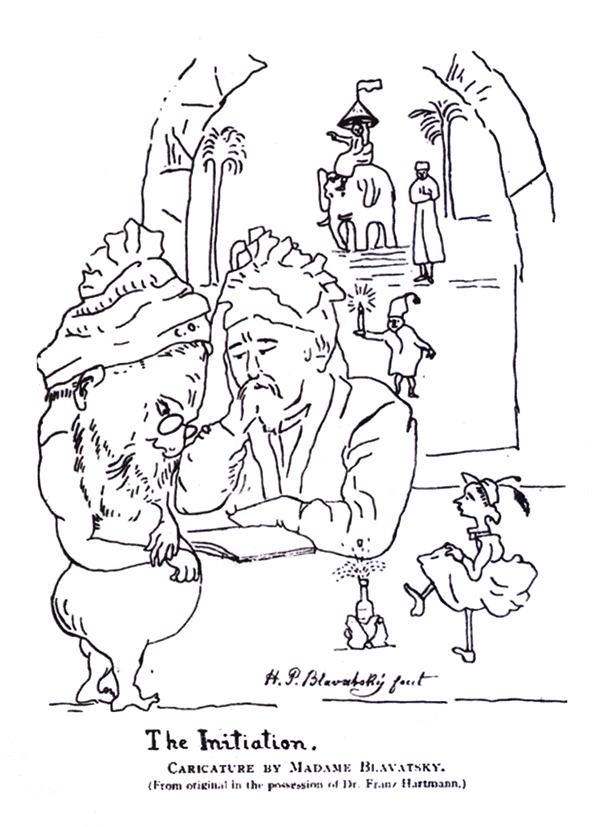
   The InitiationCaricature by Madame Blavatsky
 

A drawing by HPB, from the collection of Franz Hartmann. Hartmann writes: "She sometimes drew caricatures that were  not without artistic value and portraits that were easily recongnizable. One such represents the examination for initiation of a proninent member of the T.S.  He is evidenty unable to answer the questions asked of him by K.H. and he looks with a wistful eye at a bottle of chamagne and a dancing girl, as if he were very loath to abandon the pleasures of this life. An elemental holds a candle and in the distance is the Master M. and still further on Madame Blavasky herself sitting on an elephant."Reproduced in Hartmann's autobiographu in his Ouline of the Secret Doctrine.

Despite the profound impact of Hartmann’s work, his writings have never been compiled in a comprehensive manner until now. The Franz Hartmann Collection, launched in 2022, seeks to rectify this oversight by publishing the entirety of Hartmann’s works in both book and web format. Currently consisting of eleven volumes, the collection covers a wide range of topics, from An Adventure among the Gnomes to Hermetic Stories for Children. It also features three volumes translated for the first time from German to English by TSA board member Susanne Hoepfl-Wellenhofer: Yoga and Christianity; Mysteries, Symbols, and Occult Forces; and An Outline of the Secret Doctrine. One highlight of the collection is the inclusion, on its website, of hundreds of articles and books by Hartmann that have been translated into English for the first time by Robert Hütwohl. The collection is far from complete and is an ongoing work, with four more volumes underway.

This extensive collection of works provides a wealth of knowledge and insight into Hartmann’s teachings and philosophy, making it an invaluable resource for scholars, researchers, and enthusiasts alike. Visitors to the collection’s website, www.franzhartmann.eu, can explore the full range of Hartmann’s writings, gaining a comprehensive understanding of his contributions to the fields of mysticism, Theosophy, and alternative medicine.

The significance of the Franz Hartmann Collection extends beyond merely compiling Hartmann’s writings: it also serves to shine a light on the impact and legacy of this influential figure. It highlights the importance of preserving and reprinting the early work of Theosophists, contributing in this way to the preservation of Theosophical history. By making Hartmann’s works more accessible and readily available, the collection seeks to ensure that his works continue to inspire and educate future generations of individuals interested in esoteric and spiritual knowledge.

The collection exemplifies a passion for preserving and disseminating valuable knowledge. The meticulous effort put into translating and compiling Hartmann’s works for the Franz Hartmann Collection is a testament to the dedication and commitment of those involved in the project. Thanks to Susanne Hoepfl-Wellenhofer and Robert Hütwohl, who have worked tirelessly to bring Hartmann’s writings into the English language.

The team involved in the project consists of Doss McDavid, Erica Georgiades, Juliet Bates, Ifigeneia Kastamoniti, Susanne Hoepfl-Wellenhofer, and Robert Hütwohl. 

Erica Georgiades600x600Erica Georgiades is the director of the European School of Theosophy and the School of Wisdom. She is also the president of the Theosophical Society in Greece.

Doss McDavidDoss McDavid has been a member of the Theosophical Society since 1969.  He is a professor emeritus at the University of Texas Health Science Center at San Antonio.


Unbecoming

Printed in the  Winter 2025  issue of Quest magazine. 
Citation: Sugg, Judith"Unbecoming"   Quest 113:1, pg 40-42

By Judith Sugg

JuithSuggWhat is this elusive entity called personality? Psychology offers explanations, such as character traits and consistent patterns of thinking, feeling, and behavior. Personality is what an individual does consistently and will likely do in the future.

Yoga tells us that lifetimes create patterns, even knots, in the body that require release in order to be free of their influence. The most essential patterns are those of misunderstanding the nature of Reality, leading to confusion and pain. We see ourselves as what is contained inside our skin and thus as separate and subject to the memories, imaginings, fears, and longings of our ever-changing mind and body. With intent and practice, we sufficiently settle the mind to become open and still.

Spiritual traditions often describe personality as something to be dropped, dissolved, released, or freed of. It was an aha moment for me when a wise Theosophist said of an ongoing dispute, “It’s just their personalities.” This statement acknowledged the conflict, the agents, and the distinction between personality and the ever-present Spirit.

We believe that the entity bearing our name is real and special. For young children, this is a part of normal development and an aid to navigating the world. As adults, it is so profoundly wound into our psyche, so unconscious, that we are startled by events that demonstrate the contrary.

Many of our fondest desires center on having others recognize our specialness. In our minds, whether we are happy or suffering, we are the center, the star of the show, and the focus of attention. Being special means that we exist in comparison to others. We feel joy when we are ahead or feel anger or sorrow when we are behind. We take the self-talk in our head as reality, so we remain isolated.

Personality is a handy concept. If I know your tendencies, I predict that you will be agreeable, dependable, likely to succeed, open to ideas, fearful, steady, or changeable. As others respond to our personality, the illusion solidifies. That feeling of “this is like me” is a sense of security, whether we like the “me” or not. The more we engage in this “me” role, the dearer it becomes. What I do right belongs to me. When I suffer, it is because I am misunderstood. It seems impossible to step out of the drama of the role and see personality for what it is: imaginary.

 A Course in Miracles describes specialness as the grand illusion of existence and the “great dictator of wrong decisions.” Could we hate if we were not in competition? Could I be special if I didn’t define the “other” as someone to compete with? “To value specialness is to esteem an alien will to which illusions of yourself are dearer than the truth” (A Course in Miracles, Text, 502).

Spiritual teachings often advise against taking this personality seriously—it’s a lie, a confusion, an error. We spend time and energy improving our body, mind, health, and economics. Sometimes we seek to strengthen relationships and find alignment with a spiritual or philosophical system that seems to confirm our views. We build what we deem is good in our character. Yet spiritual teachings also call us to leave these patterns in the dust. They call us to relinquish our specialness and become the light we always were but haven’t been able to imagine. How do we harmonize these seemingly disparate goals?

Jean Klein, a spiritual teacher in the Hindu Advaita Vedanta tradition, would say that becoming is the issue. We are almost always in the becoming mode; we are never just here. We search for experience, not truth. We desire many things, feelings, and achievements. But when we finally get the object of desire, it has little meaning.

There is an old story of a student asking the master how long it takes to be enlightened. The master says, “Five years.” The student asks, “But what if I really try?” The master says, “Ten years.” In Klein’s terminology, setting the goal (faster enlightenment) sets the student in the becoming mode, waiting for the next experience, and thus sets up the pattern that sustains the personality.

Experience is not Reality. An experience may be incredible, and yoga, meditation, prayer, hypnosis, singing, drugs, and other things can give us an experience of peace and joy. We like that experience—I like that experience. But the experience too is measured on the scale of like and dislike, and we don’t break free. In fact, we addict ourselves to the experience. We let the experience of a positive emotion, like love, joy, or peace, become an object of desire.

As a yoga teacher of thirty years, I love the happiness and release the practice brings. I also love seeing students have their own experiences of joy and stress release. As wonderful as that is, it is not freedom from the judging mind. It is still pleasant versus unpleasant, good or bad, and it is still the tyranny of personality.

Klein views discernment as “the only decisive fact in knowledge” (Klein, Be Who You Are, 63). Although he offers no formulas or prescriptions, he speaks of discrimination as an essential act. The mind can learn to discriminate between ego/personality and what is not. What is not the personality is impersonal, present, transparent, curious, alive, and open. Judgment relies on memory and creates more memory, more fuel. “Triumph is what fortifies the ego, and disaster is what destroys it. Now, the ego is an error. The error of separatism, of the wave which takes itself to be distinct from the ocean” (Klein, Be Who You Are, 68).

The distinction between what is Real and what is not is at the heart of the teachings of the Samkhya, another school of Hindu philosophy. Samkhya is usually translated as enumeration. Discernment is the reason for enumerating all the aspects that are not pure consciousness. Why enumerate them? So one knows what is not Real. The study of these enumerated principles “implies much more than ordinary study. It implies, rather, a fundamental change in the back orientation of a man. It implies a kind of intuitive realization or discrimination which separates out pure consciousness from everything that is not consciousness” (Larson, 205).

Klein offers some practical advice on avoiding the trap of experience and the mental cycle of judgment. He advocates moment-by-moment observation of oneself. Observing oneself involves psychological separation, stepping out of one’s shoes and emotions, and witnessing the cycle of reaction and desire. As long as we are caught in these cycles, we are trapped in becoming something, getting happiness, staying safe, avoiding pain, gaining attention—whatever our conditioning entails. The cycles don’t end; they create more reactions, projections, and desires.

Eventually, without intervention or intention, a “certain elimination” occurs, and what is left to observe subsides into nothingness. There is a loss of fascination with the desires of the personality. Our attention is no longer gripped by whatever arises, and increased clarity, honesty, and stillness arise. There is less like and dislike, good and bad, winning or losing.

Personality does what it has always done: comparing, judging, desiring, being disappointed, constantly becoming, obtaining, reaching. In other words, we are never here right now. How is it possible to halt the return to the old self?

As a society, we pay attention to the body in terms of looks and health. We pay scant attention to the connection of thought and body. Although any reaction results in both thought and a contraction in the body, we overlook the indicators of the body and the resulting emotions. We read tension in the belly as fear, then we hold on to the fear with thoughts and images in our minds. What is your favorite way of stopping that transformation?

When we meditate, drama subsides. We feel uplifted, open, free, and compassionate. Meditation training allows us to slow down and step back out of the habit of reaction. We note the gigantic distances between the end of one breath and the beginning of the next, and we drop into more presence. With the help of distance and perspective, we take time to assess what is happening. We note the reaction of the body, not just the mind, and we consciously release the body’s tension and contraction. We return to the present.

Klein spent much time developing deep and minute relaxation at the body level—not to feel good, but to allow the body to fulfill its function. The deep practices of savasana or yoga nidra begin this journey. However, they are still experiences; they are not complete or permanent.

Imagine a scene where another person is extravagantly praised in your presence for actions you have done. Notice the thought, which may be akin to anger or jealousy. Observe the contraction and the emotional irritation. Use the muscle of discrimination to slow down and notice the pattern, the cycle of reactions, and the tension. What is this truly about? What is the underlying need at a psychological level? Is it a bid for attention? Is it self-criticism? Safety? Peace? Psychological understanding is vital in the moment. We want to be noticed so we feel loved. We want to ensure safety and feel complete. Whatever convoluted strategies we use to feel good psychologically, acknowledging the need helps unwind the cycle and the conditioning.

Examining these needs and tracing them to their core provides release and peace. Yet, it is still the experience of the personality. What translates this into the ultimate discrimination of Real and not real? Klein offers only subtle pointers but emphasizes that detachment from the personality means the absence of desire, because we have realized that what we desire will never keep its promises. The moment-to-moment releasing of conditioning, the relinquishment of goals, the escape from comparison and competition, and the letting go of distinction, of specialness, are all a part of it. When we let go of becoming, we are.

Try this experiment: Remember a slightly disturbing interaction with one person. As you remember, in your mind’s eye, bring the other person to your eye level. Look at them directly at eye level. This isn’t about height or actual discrepancy; it is about how we remember someone as above us or beneath us. It’s how we identify whether a person is better, more powerful, or less. Bringing them to eye level in our memory is a small step in releasing habits of comparison.

Reading Klein is like reading a hologram: it is whole in each part. It reflects the spirit he brought to his teaching, the presence he extends through his words. His highest teaching is stillness in the silence of listening (much like the inner sound that kills the outer in The Voice of the Silence). Klein notes that when our senses are free of motive, they no longer belong to the body. Attention without qualification appears as a global presence: “In the end even hearing and seeing dissolve into this presence and you are one with it. Ultimately there is no longer a subject who sees nor an object which is seen. There is only oneness” (Klein, Ease of Being, 7).

Sources

A Course in Miracles. 3d ed. Tiburon, Calif.: Foundation for Inner Peace, 2007.

Klein, Jean. Be Who You Are. Oakland, Calif.: Non-Duality Press, 1978.

———. The Book of Listening. Oakland, Calif.: Non-Duality Press, 2008.

———. The Ease of Being. Salisbury, U.K.: New Sarum Press, 2020.

———. Who Am I? The Sacred Quest. Longmead, U.K.: Element, 1988.

Larson, Gerald. Classical Samkhya. New Delhi: Motilal Banarsidass, 2011.

Judith Sugg, PhD, is a counselor, psychology instructor, and yoga teacher. Her graduate work was in the psychology of yoga and the Samkhya, and she wrote the Study Guide for the Yoga Sutras for the Theosophical Society.


From the Editor's Desk - Winter 2025

Printed in the  Winter 2025  issue of Quest magazine. 
Citation: Smoley, Richard"From the Editor's Desk"   Quest 113:1, pg 40-42

This issue features an unusual amount of material about H.P. Blavatsky, including excerpts from the long-awaited second volume of her letters. We are even running an amusing caricature she drew.

All of this leads me to reflect on the role of HPB in today’s Theosophical Society. Blavatsky’s image looms heavily over the present-day TS (and perhaps still more over other branches of the Theosophical movement). At the risk of injecting yet another acronym into today’s cluttered mental universe, I have the sense that many Theosophists act according to the principle of WWBT: “What would Blavatsky think?”

HPB is an idol to some and an object of mockery to others. She is either infallible sage or pathetic trickster, getting her carpenter to build funny little cabinets to deceive the weak-minded. As usual, both of these extremes seem misguided and unhelpful.

I think the best capsule description of HPB is in a short biography by her associate Franz Hartmann (see page 48): “To me she always appeared as a great spirit, a sage and initiate inhabiting the body of a grown-up capricious child, very amiable on the whole but at times very irascible, ambitious, of an impetuous temper, but easily led and caring nothing for conventionalities of any kind.”

Whether HPB would agree with this assessment or not (which of us would agree with similar assessments of ourselves?), it seems to do succinct justice to both her virtues and flaws.

I don’t propose to deal with the historical Blavatsky in this editorial. An enormous amount of information about her is available, and there are many people who are far more familiar with it than I am. 

Rather, it is the reified image of HPB that I wish to address. Sometimes it appears that people have a kind of simulacrum—an image of HPB—residing in their heads, perhaps as ideal, perhaps as superego, glaring at them every time they eat a hamburger or drink a glass of beer.

A well-known Buddhist adage says, “If you see the Buddha on the road, kill him.” That is, any image of the Buddha you come across on the spiritual path is not the true Buddha—the true enlightened mind—but a distraction (created by your own mind; whose else?). You need to recognize it for what it is and go past it.

I have a strong sense that a similar mental image of HPB (which varies according to individual tastes and neuroses) is an obstacle for many on the Theosophical path. I also have the sense that a similar image, collectively generated, is an obstacle for the progress of the Society as a whole.

One area in which this problem is especially obvious is present discussions of Theosophy in conventional academic circles. I have made some comments about these issues on page 17. Certainly the scholars in question are accountable for their own obliviousness. Even so, responses to this kind of scholarship from Theosophists have been weak and halting, because they often seem to want more to reactively defend Blavatsky than look at her clearly and impartially. It would appear that in any scholarly inquiry, the first casualty is objectivity.

I follow this academic discourse as a matter of professional duty, but I confess that I find it of limited interest. In the first place, your opinion of whatever happened way back then will be heavily conditioned by your preconceptions. Do you believe in telepathy, psychokinesis, and so on, at least theoretically? If so, your picture of the early Theosophical movement will differ radically from that of those (and this includes most if not all mainstream scholars) who categorically reject such possibilities.

 More importantly, I think it is a mistake to cage up the Ageless Wisdom in the past. Blavatsky, Olcott, and their associates are fascinating personalities, but if you are really intent on going through the Hall of Learning, you will focus on internalizing the teachings. This includes not only conceptual understanding and living in accord with certain ethical principles, but being able to relate esoteric ideas with your own experience. It is one thing to talk about the astral body (for example) as discussed in the Theosophical texts and quite another to speak about it from your own lived experience.

We learned this lesson in school: in order to demonstrate true understanding, you not only had to know the concepts as a matter of rote learning but be able to express them in your own words. In my opinion, this is even more true for esoteric work. That it is also far more difficult should not be either an obstacle or an excuse.

Richard Smoley


Viewpoint: In Pursuit of the Golden Fleece

Printed in the  Winter 2025  issue of Quest magazine. 
Citation: Keene, Douglas"Viewpoint: In Pursuit of the Golden Fleece"   Quest 113:1, pg 10-11

By Douglas Keene

Doug KeeneIn Greek mythology, the flying winged ram Chrysomallos was the offspring of Poseidon, the god of the sea, and Theophane, the daughter of Bisaltes, who in turn was the son of Helios and Gaia (Sun and Earth).
The ram rescued Phrixus, a youth who was about to be sacrificed by his father, the king of Iolkos (a city on the Aegean coast of Greece, which survives today as a village), and took him to Colchis, a region on the eastern coast of the Black Sea. Here Phrixus took refuge with the king, Aeëtes, and sacrificed the ram to Zeus. The ram was transformed into the constellation Aries.

Chrysomallos means gold wool, because the ram’s fleece was golden. Aeëtes hung it on an oak tree in a grove sacred to the Greek god of war, Ares. Here it was guarded by a large sleepless serpent, the Colchian Dragon. Jason, the mythological hero, embarked on a journey with the great hero Heracles and many warriors on a mighty ship, the Argo, to retrieve the fleece.

After a multitude of challenging adventures common among mythological figures (defined as heroes in these roles), and with the assistance of Aeëtes’ daughter, Medea, Jason succeeded in repelling all evil forces and obtained the object of his search.

On the way to fetch the fleece, Jason and his companions, the Argonauts, stopped in the land of the Doliones. Here they are confronted by Gegenees (whose name means aboriginals), hideous monsters with six arms. Led by Heracles, the Argonauts slaughtered the “stubborn, frenzied attackers” (as they are described in the famous epic poem the Argonautica).

In the legends of the Greeks and many other peoples, monsters, demons, devils, and serpents frequently appear as obstacles to attaining the target of pursuit. In terms of our own inner development, they are often metaphors for internal obstacles met when embarking on a spiritual journey, symbolizing the weaknesses and flaws that we must overcome to seek purification and redemption. They need to be “slain” in order for each of us to advance.

We usually find that the hero is assisted by an unlikely source, frequently with a divine connection, that serves as protector, guide and teacher. Each ordeal is calculated to strengthen the hero and deliver him or her through adversity in order to claim the prize. While many fail and fall, the hero will progress, even if it appears that all is lost at some point in the long and arduous journey.

There may be some fact behind this ancient myth. The Golden Fleece may sound entirely fantastic, but in certain regions of the Black Sea, the inhabitants used to put fleeces in rivers to trap flakes of gold. This may help explain this mystifying detail.

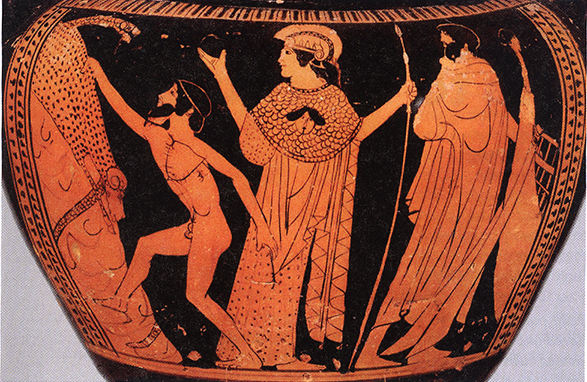
  Golden Fleece
Jason recovers the Golden Fleece from a sacred tree in the grove of Ares. The head of the fleece's guardian, Dragon-Serpent, darts towards the hero. The goddess Athena, wearing a helm and the aegis-cloak, oversees the endeavor. Behind her stands an Argonaut and the prow of the ship Argo. Attic red-figure vase, attributed to the Orchid Painter, c.470‒60 BC, Metropolitan Museum of Art.

What is the message of this mythological journey? What does the Golden Fleece represent? One interpretation is that it symbolizes that which is nearly unattainable or cannot be easily possessed. Another is that the fleece is a symbol of refinement of sensitivity which elicits awakening and spiritual purity.

In any event, the hero’s journey is central to Greek mythology as well as to those of most cultures. It usually involves an arduous search for something elusive, something divine and powerful that is protected by obstacles of various kinds, fierce and mysterious, and often unknown.

The story of the Holy Grail in the Arthurian tales is another example. The earliest version of this legend (which has many variants) is found in the verse romance Perceval, written in the late twelfth century by the French poet Chrétien de Troyes. In it the youth Perceval (or Percival), seeking knighthood, sees the Grail in a mysterious procession in an enchanted castle. It is being carried by a young woman.

Perceval is curious about this strange procession but does not ask what it is about. Later he is told that this was a mistake, because if he had asked the “Grail question,” it would have removed a curse from the land. Perceval goes in search of the Grail, but in Chrétien’s unfinished poem never finds it. In another version, Arthur’s knight Sir Galahad, who is pure of heart, takes up this mission, and eventually has a vision of the Grail.

The Holy Grail has become synonymous with an object of great desire but is shrouded and sequestered, requiring great sacrifice to obtain. King Arthur realizes he is unable to find the Holy Grail, but perhaps his purified warrior can. These figures can be interpreted as aspects of ourselves.

As Joy Mills writes in Entering on the Sacred Way, “the hero of this legend is a guileless and innocent youth, a widow’s son, who is seeking a treasure hard to find . . . What is relevant to our present study is that in the Percival or Parzifal version of the legend we have a precise illustration of the requirements for discipleship, the essentials for the aspirant’s achievement of ‘kingship’ or ‘adeptship.’”

Here again we see the struggles of the protagonist searching with determination and sacrifice for the magical icon, willing to sacrifice all and abandon comfort, home, and community with the hope of reaching that sacred space. This resembles Gautama’s leaving the protection (or rather overprotection) of his family and high rank, to seek the world for purpose and truth. Eventually he attains enlightenment and becomes the Buddha.

Are these merely stories of people long ago and far away, or does its symbolism apply to our own lives? Is it relevant to our own challenges here and now?

H.P. Blavatsky wrote frequently about this quest for the nearly unattainable, and her book The Voice of the Silence is essentially a treatise on the spiritual path. In another important text, “There Is a Road,” she begins: “There is a road, steep and thorny, beset with perils of every kind, but yet a road, and it leads to the very heart of the Universe.”

“Perils of every kind” certainly can be intimidating. This is not a casual exercise, and these rewards do not come easily. The seeker must be willing to sacrifice all attachments in order to reach his or her goal. But as HPB tells us, for those who are committed to the journey—and ultimately to the “reward”—there is a path forward. If we are not ready, we will fail. But even in failure, lessons are learned. Failure is not permanent. Each adventure prepares us for the next.

Annie Besant, in her book The Outer Court, uses the metaphor of a temple with an outer court atop a mountain. She writes: 

If we look more closely at the temple, if we try to see how that temple is built, we see in the midst of it a holy of holies, and round about the center are courts, four in number, ringing the holy of holies as concentric circles, in these are all within the temple . . . So all who would reach the center must pass through these four gateways, one by one. And outside the temple there is yet another enclosure—the Outer Court—and that court has in it many more persons than are seen within the temple. Looking at the temple and the courts and the mountain road that winds below, we see the picture of human evolution, and the track along which the race is treading, and the temple that is its goal.

This image metaphorically gives us the grand panorama to which most of us are blinded as, incarnated in a single lifetime, we struggle to find our own direction and goals. But by using the temple as a beacon, we can direct our progress by a much more focused and strenuous effort in finding our way up the mountainside. Even the interim goals may be largely unknown to us, but if we follow this guiding ideal, our travel will be rewarded.

Each of us may ask ourselves what we are committed to. What will be our Golden Fleece—that to which we are willing to sacrifice, to devote our efforts, our passion, and even our lives? Are we willing to plunge into the unknown and slay our demons and our impurities? It may seem to be a journey without end, and indeed may last many lifetimes. But we are not alone, and there is help for those who seek it. Are we ready?


Subcategories