

Threads of Unity: Theosophy and the Science of Strings
Printed in the Winter 2026 issue of Quest magazine.
Citation: Banerjee, Yajnavalka "Threads of Unity: Theosophy and the Science of Strings" Quest 114:1, pg 31-33
By Yajnavalka Banerjee
Across the ages, humanity has sought a fundamental unity underlying the diverse phenomena of nature. The ancient seers gazed at the heavens and intuited hidden harmonies. The Greek mystic Pythagoras, whose philosophy interwove mathematics with music, famously declared, “There is geometry in the humming of the strings. There is music in the spacing of the spheres.” Such reflections suggest that the cosmos itself may be structured by principles akin to those of harmony and vibration. Centuries later, Albert Einstein voiced this same yearning in the language of modern physics: “I want to know how God created this world . . . I want to know His thoughts; the rest are just details.”
This timeless pursuit—to discern the one law, the one rhythm, the one meaning—has animated both mystics and scientists. The conviction that nature, at its core, is one has inspired quests as varied as the alchemical search for the prima materia and the physicist’s search for a theory of everything.
While modern science and ancient wisdom are often portrayed as antagonistic, they converge in this shared aspiration. Indeed, the founders of the Theosophical Society in the nineteenth century argued that science, religion, and philosophy are not separate but complementary avenues to truth. H.P. Blavatsky, the principal architect of modern Theosophy, subtitled her magnum opus The Secret Doctrine as The Synthesis of Science, Religion, and Philosophy, thereby affirming, with characteristic boldness, that these realms of knowledge are intrinsically interwoven.
HPB’s plea was that modern science and ancient spiritual philosophy should join hands in unveiling “the reality of the occult in nature” and demonstrating that the laws of physics and the truths of the soul ultimately spring from a common source. As HPB’s biographer Sylvia Cranston notes: “What has fascinated scientists who have studied The Secret Doctrine is that the author anticipated many later discoveries in their own fields. When physicists and chemists of her day were convinced that the atom was the ultimate building block of the universe, she affirmed its infinite divisibility.”
Einstein’s own engagement with Blavatsky’s writings was not merely incidental: as Cranston recounts, “A niece of Einstein reported that a copy of The Secret Doctrine was always on his desk” (Cranston, xx).
In this spirit of synthesis, we explore the conceptual bridge from strings to the Logos, from one of the boldest theories of modern physics to the ageless insights of Theosophy, seeking resonances that might harmonize material knowledge with spiritual understanding.
String Theory as a Cosmic Symphony
Modern physics, in its relentless pursuit of unification, has developed string theory, a framework attempting to reconcile Einstein’s general relativity with quantum mechanics. At its heart, string theory proposes that the most fundamental units of reality are not point-like particles but unimaginably tiny strings of energy vibrating at specific frequencies (Greene, Morrison, and Polchinski).
To envision this, one might liken each fundamental string to the string of a violin. Just as a single violin string produces different notes depending on how it vibrates, a cosmic string’s vibrational mode determines the type of fundamental particle it appears to be. An electron, a photon, or a quark are thus different “notes” played by the same cosmic instrument. In this framework, all forces and particles are unified as variations of the same basic theme, the “music of the strings.”
The simplicity of this idea lies in its power. It suggests that the immense complexity of physical reality emerges from one fundamental principle: vibration. This aligns curiously with the philosophia perennis, which has long asserted that behind all forms lies one underlying unity.
Another remarkable feature of string theory is its insistence on extra dimensions beyond the familiar three of space and one of time. Most versions of string theory require at least ten dimensions, while M-theory proposes eleven. These additional dimensions are thought to be compactified or hidden from everyday perception.
Although abstract, this vision of a multilayered cosmos resonates with ancient metaphysical teachings that speak of planes of existence beyond the physical (Penrose, 15).
For now, string theory remains a mathematical hypothesis rather than an experimentally confirmed fact. Yet its appeal lies in its ability to harmonize concepts once thought irreconcilable: gravity, quantum phenomena, and the very fabric of space and time. Its vision of unity through vibration echoes age-old spiritual philosophies and sets the stage for a dialogue with Theosophy.
Theosophy and the Creative Vibration
Theosophy, as presented by HPB and the Mahatmas, is a modern expression of an ancient wisdom tradition. It teaches that the universe is fundamentally one, a living, conscious whole. in this view, the material world is but the outer garment of a spiritual reality, and every physical law reflects a deeper cosmic principle.
One of the strongest parallels between Theosophy and string theory lies in their shared emphasis on vibration as the foundation of existence. In Theosophy, the concept of the Logos or the Divine Word signifies the creative sound or vibration that brings the cosmos into manifestation. This notion is deeply rooted in ancient traditions, from the Om of Hinduism to the opening of the Gospel of John: “In the beginning was the Word, and the Word was with God, and the Word was God” (John 1:1).
HPB speaks of Fohat, the dynamic energy of cosmic ideation, as “the bridge by which the ‘Ideas’ existing in the Divine Thought are impressed on Cosmic substance as the ‘laws of Nature’” (Mills, 2009). This is strikingly reminiscent of string theory’s claim that vibration, the mode of a string, gives rise to all forms of matter and force. Both perspectives see reality as fundamentally vibrational, as a symphony of frequencies woven into the fabric of being.
A Comparative View: Strings and Theosophy
To illustrate the conceptual resonances between these two worldviews, the following table highlights key areas of similarity:
|
Aspect |
String Theory (Physics) |
Theosophical Principles: The Secret Doctrine) |
Interpretational Similarity |
|
Fundamental building blocks |
Reality arises from one-dimensional vibrating strings. |
All forms emerge from the One Reality (Parabrahman), the root of existence. |
Both posit a unified foundation of all phenomena. |
|
Vibration as foundation |
Particle types depend on the vibration of strings. |
Fohat manifests the “ideas” of the Divine through vibration. |
Vibration is the creative principle in both views. |
|
Extra dimensions |
Requires 10 or 11 dimensions beyond the visible 3 dimensions. |
Describes planes of existence beyond the physical (astral, mental, spiritual). |
Both propose unseen realms that are integral to reality. |
|
Unity of forces |
Seeks to unify gravity, electromagnetism, and nuclear forces. |
Asserts that all natural forces are expressions of the One Life. |
Both aim for an overarching unity. |
|
Infinite divisibility |
Suggests substructures beyond particles. |
HPB rejected the atom as indivisible, affirming infinite divisibility. |
Both view matter as emergent, not fundamental. |
|
Cosmic symmetry |
Relies on mathematical symmetries (supersymmetry). |
Speaks of universal harmony and balance. |
Symmetry is seen as a core principle of order. |
|
Origins of the universe |
Proposes quantum fluctuations or brane [sic] collisions. |
Teaches cyclical manifestation (Manvantaras and Pralayas). |
Both explore creation from the viewpoint of subtle potentialities. |
|
Consciousness and observation |
Quantum theory hints at observer roles. |
Consciousness is fundamental; matter is its vehicle. |
Both acknowledge deep interconnectedness. |
|
Goal of knowledge |
A unified theory explaining all phenomena. |
A synthesis of science, religion, and philosophy. |
Both strive for holistic understanding. |
These parallels do not suggest that Theosophy predicted string theory in scientific detail. Rather, they show that both systems, in different languages, point to a reality that is vibrational, unified, and multilayered. Although not predictive in the strict scientific sense, Theosophy, as we noted earlier, anticipated key scientific ideas: for example, HPB posited principles such as the infinite divisibility of matter long before they entered modern scientific discourse.
Multidimensional Reality
String theory’s insistence on hidden dimensions resonates with Theosophy’s teaching of a sevenfold cosmos. Beyond the physical plane lie astral, mental, and spiritual realms, each more subtle than the last. William Q. Judge, a cofounder of the Theosophical Society, described this layered universe as “the Absolute, Spirit, Mind, Matter, Will, Akasha or Aether, and Life” (Judge, 15).
Similarly, string theory’s extra dimensions are unseen yet essential to its structure. Though the mathematics differs from Theosophy’s metaphysical map, both assert that what we perceive is only a fraction of a much greater reality.
Unity of Matter and Force
String theory seeks to unify all physical forces. Theosophy anticipated such a unity, teaching that “matter is crystallized spirit” and that all forces—electricity, magnetism, heat—are manifestations of one primordial energy: Fohat (Mills). Blavatsky’s Theosophical Glossary describes this energy as “the universal propelling Vital Force” (Blavatsky, Glossary, 121), a principle not merely mechanical but imbued with intelligence. Einstein’s equation, E = mc2, revealing the interchangeability of mass and energy, echoes Theosophy’s assertion that matter and energy are two faces of the same coin. Both perspectives see diversity emerging from a single underlying principle.
Cyclic Evolution and Rhythms of the Cosmos
String cosmology has inspired models of a cyclic universe, expansions and contractions, big bangs and big crunches. Theosophy similarly speaks of Manvantaras (periods of manifestation) and Pralayas (periods of dissolution), envisioning the universe as the “Great Breath,” inhaling and exhaling worlds across vast spans of time. HPB wrote: “The appearance and disappearance of worlds is like a regular tidal ebb of flux and reflux” (Secret Doctrine, 1:13‒17). This mirrors modern theories suggesting that time itself may be cyclic rather than linear.
Thought-Forms and Vibrational Mind
A fascinating Theosophical concept is that thoughts themselves are vibrations capable of shaping subtle matter. Annie Besant and C.W. Leadbeater explored this in their classic work Thought-Forms, arguing that each emotion or idea radiates a distinct vibrational pattern. Modern science, though using a different vocabulary, is beginning to appreciate the vibrational nature of thought and perception. Neuroscience, for example, maps brain activity in terms of oscillatory patterns, while physics and information theory increasingly view reality as a web of interwoven signals.
Dr. Hippolyte Baraduc’s experiments with photographing thought-energy further illustrate this principle (Besant and Leadbeater, 4). Just as string theory reduces matter to vibration, Theosophy extends the same principle to consciousness. In this view, the human mind is both a receiver and transmitter of subtle waves, linking microcosm and macrocosm.
Strings and Logos in Harmony
At its highest level, string theory aspires to a theory of everything, a framework that unites all particles, forces, and interactions. Theosophy too is a philosophy of unity, teaching that there is no dead matter, only the one Life manifesting through countless forms. The Logos, in Theosophy, is the cosmic musician whose song shapes the universe. String theory, in its most poetic interpretation, imagines the universe as a vibrating symphony. Both perspectives affirm that the universe is neither random nor inert, but ordered and alive.
Conclusion
The journey from strings to Logos is not a leap from science to mysticism but an exploration of the common ground where they meet. String theory, with its vision of vibrating energy as the source of all things, and Theosophy, with its doctrine of the creative Word, both affirm that unity and vibration lie at the heart of existence. As Einstein sought “God’s thoughts,” Theosophy reminds us that these thoughts are not merely equations but expressions of meaning and consciousness. To see the cosmos as both a mathematical structure and a spiritual symphony is to glimpse a richer truth, one in which science and Theosophy are partners in the same quest.
Sources
Besant, Annie, and C.W. Leadbeater. Thought-Forms. Wheaton: Theosophical Publishing House, 2015 [1905].
Blavatsky, H.P. The Secret Doctrine: The Synthesis of Science, Religion, and Philosophy. Three volumes. Wheaton: Quest, 1993 [1888].
———. The Theosophical Glossary. London: Theosophical Publishing Society, 1892.
Chin, Vicente Hao, Jr., ed. The Mahatma Letters to A.P. Sinnett in Chronological Sequence. Quezon City, Philippines: Theosophical Publishing House, 1993.
Cranston, Sylvia. H.P.B.: The Extraordinary Life and Influence of Helena Blavatsky: Founder of the Modern Theosophical Movement. New York: Putnam, 1993.
Greene, B.R., D.R. Morrison, and J. Polchinski. “String Theory.” Proceedings of the National Academy of Sciences of the USA 95, no. 19 (1998): 11039–11040.
Judge, W.Q. The Ocean of Theosophy. New York: The Path, 1893. Reprint, Wheaton: Theosophical Publishing House, 2003.
Mills, Joy. “On Fohat.” Quest 97, no. 1 (fall 2009): 17–19, 29.
Penrose, Roger. Fashion, Faith, and Fantasy in the New Physics of the Universe. Princeton, N.J.: Princeton University Press, 2016.
Yajnavalka Banerjee is a professor of biochemistry whose research in cancer biology and biophysical chemistry has been widely published in international peer-reviewed journals. A passionate teacher of physics and biochemistry, he brings a reflective curiosity to the intersection of science and spirituality. An avid reader of Theosophical literature, he is particularly interested in how modern scientific insights resonate with the timeless wisdom of the esoteric traditions.
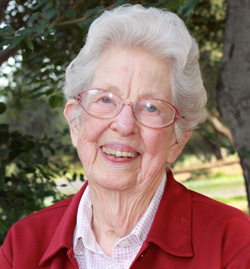 Joy Mills (1920‒2015) is one of the most admired and beloved figures in the Theosophical Society. She dedicated her life and career to the Society in a way that few others have. She joined the Milwaukee Lodge at the age of twenty, and from that time on was active in innumerable aspects of the TS.
 TS meetings have changed drastically since their inception at the end of the nineteenth century, thanks to ever-increasing technology. Now meetings are announced by email, social media, and websites—all means of communication that didn’t exist until around twenty-five years ago. The subject matter of meetings can be taken from videos of talks downloaded from the TSA website or YouTube. Even the meetings themselves are often as not conducted virtually on Zoom or other platforms. The founders would think it unimaginable that lodge meetings might not occur in actual lodge buildings, but rather with each member sitting in the comfort of their own home. “Flapdoodle!” or “Humbug!” HPB would undoubtedly exclaim.
 It was the fall of 1965 in New Delhi. My wife had asked me to deliver something to Mrs. Kitty Shivarao, who had been very kind to her when, four years earlier, she had come to India as a volunteer from Canada. I went on my bicycle and came to a sudden stop in front of a very tall man sitting on a wicker chair completely alone on the porch of the Shivarao house. I wondered if Mrs. Shivarao was in, and the man, who was extremely self-contained, said he would go in and look. Without any hurry, but without delay, he went in and returned to say that she was not there but that I could wait until she got back. I do not recall why I could not wait; perhaps I had the usual haste of the young, especially those recently returned from a long stay in the West. I handed over to him what I had to deliver to the lady of the house and rode away on my bicycle. But I kept looking back at this unusual man with an extraordinary presence, sitting on the porch, until I fell from my bicycle, having crashed into a woman carrying a large bundle on her head.